
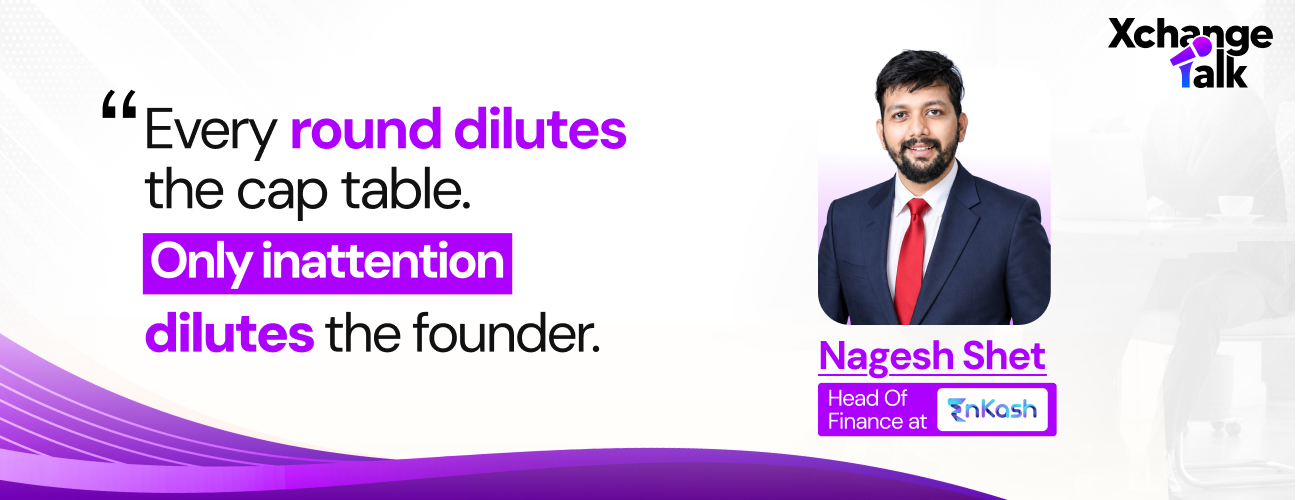
Every founder can recite the cap table from their first term sheet without looking.
Ownership percentage. Option pool size. Who holds what, and why.
That number lived in their head for months before the ink dried.
Three funding rounds later, most founders can't tell you the same thing with any confidence.
At signing, the cap table is simple enough to hold in memory.
One or two co-founders. An early investor or two. A modest option pool set aside for the first hires.
Every number has a story behind it, because the founder negotiated each one personally.
That clarity doesn't survive contact with growth.
Each new round brings its own term sheet, its own lawyers, its own urgency.
The pressing question in every raise is how much capital comes in; not how much ownership goes out.
Option pools get “refreshed” before each round closes, a detail buried in the term sheet rather than the headline number.
By the time the round is signed, attention has already moved to hiring plans and revenue targets.
Nobody is deliberately looking away. The cap table just stops being the thing anyone is watching.
None of this shows up as a single dramatic event. It compounds quietly, round after round:
Until the founder holding the company together owns less of it than almost anyone assumes.
This isn't a founder-by-founder story. The pattern is consistent enough to be data, not anecdote.
For example:
None of these numbers are edge cases. They show up in the median startup, not the unlucky outlier.
Laid side by side, the pattern is hard to miss:
| Round | What Founders Notice | What's Actually Happening |
|---|---|---|
| Seed | Signing the first term sheet | Option pool created pre-money; first real dilution begins |
| Series A | Celebrating the raise | Median founder ownership already down to roughly 36% |
| Series B | Chasing growth metrics | Board control shifting faster than economic ownership |
| Down round | Fighting for runway | Anti-dilution clauses can erase years of ownership in one event |
| Exit | Counting the payout | Liquidation preference stack decides who actually gets paid first |
Losing track of the cap table has a real cost.
Founders negotiate valuation hard and let option pool timing pass without a second look.
Liquidation preferences get treated as boilerplate, right up until an exit reveals who actually gets paid first.
Board composition shifts quietly, round after round, until decisions that once needed a founder's sign-off no longer do.
And the gap between perceived ownership and actual ownership only becomes visible at the worst possible moment: a down round, or an exit.
Two very different companies, two very different endings, same underlying mechanism.
By the time Walmart acquired a majority stake in Flipkart for $16 billion in 2018, founders Sachin Bansal and Binny Bansal held roughly 5% and 4.24% of the company they built. No single round did that on its own. Nine years and multiple funding rounds did.
WeWork tells a sharper version of the same story. In January 2019, the company was valued at $47 billion. By October, after a SoftBank rescue financing forced by a collapsed IPO, that valuation had fallen below $8 billion, and SoftBank walked away with roughly 80% of the company. One down round, structured under pressure, did more damage to founder ownership than years of ordinary dilution combined.
Same mechanism. Different speed.
Founders who protect their ownership don't avoid dilution. Dilution is the price of capital, and refusing it usually just means refusing growth.
What they protect instead is visibility.
They model dilution before signing a term sheet, not after.
They negotiate option pool timing and size as its own line item, not a rounding error.
They read the liquidation preference stack as carefully as the valuation headline.
They treat the cap table as a living document to revisit every round, not a file to check once and forget.
The cap table doesn't get complicated all at once.
It gets complicated one round, one option pool refresh, one term sheet clause at a time.
Not a legal problem. Not an investor problem.
A founder-attention problem, wearing a different clause every time it shows up.
Author,Nagesh Shet