
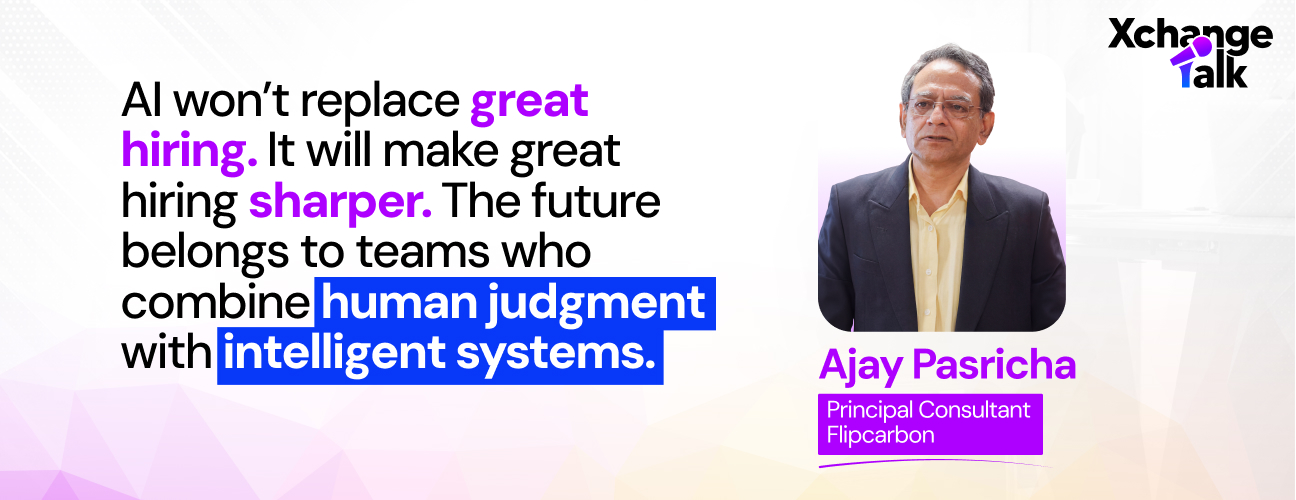
Over the last three decades in hiring, I've seen one pattern repeat itself again and again.
We don't struggle to find candidates.
We struggle to recognise the right ones.
And that's a very different problem.
Let's start with an honest question
Have you ever come across a candidate after the role was closed and thought,
It happens more often than we admit.
Not because hiring teams aren't capable.
But because the system we rely on has its limits.
Today, most hiring processes are built for speed.
We receive hundreds of applications.
We scan resumes in seconds.
We do a very fast shortlist and move on.
It seems efficient on the surface.
But here's the problem:
And that's exactly where good candidates get missed.
A resume is supposed to represent a person's capability.
But in reality, it represents their ability to write or present themselves.
And those are not the same things.
Some of the strongest candidates I've seen:
But when you actually speak to them,
They outperform expectations.
Unfortunately, most never get that chance.
Even when candidates make it to screening,
decisions are still influenced by the following:
Now, this is called Unconscious Bias
It's simply how human decision-making works under pressure.
When time is limited, we simplify decisions.
And in doing that,
We sometimes overlook real potential.
Think about it.
We make the decision about a candidate's fate in:
That's a very short period to judge someone's
So of course we adopt shortcuts.
But shortcuts don't always make the best decisions.
And this is where the real cost comes in
Not hiring a good candidate isn't simply a hiring mistake.
It creates a Ripple Effect: One small gap that slowly turns the decision into multiple bigger problems
Over time, these small misses turn into larger gaps in the organization.
So, what really needs to change?
The answer isn't just “better recruiters” or “more interviews".
From filtering candidates to understanding them better.
And this is exactly where AI starts to make a difference.
There's a lot of noise around AI in hiring.
But when used correctly, its role is quite simple.
It helps us see clearly.
For example, AI can:
In short, it removes the distractions.
This allows human judgement to focus on what really matters.
But here's what's important
AI is not the decision-maker.
It's the enabler.
Because hiring is still human at its core.
And those decisions will always need human insight.
The organizations that will hire better are not the ones using AI the most.
They are the ones using it right.
They will:
Use AI for clarity and consistency
Use Humans for judgment and context
And most importantly,
Need to stop relying only on surface-level signals and decisions.
Good candidates are not rare.
What's rare is the ability to identify them consistently.
If we continue to depend only on resumes and quick interviews,
We will keep missing people who could have made a real impact.
But if we combine better systems with better thinking,
We don't just improve hiring.
We improve outcomes.
I'd love to hear your perspective.
Have you seen strong candidates get overlooked in your organization?
Author,Ajay Pasricha